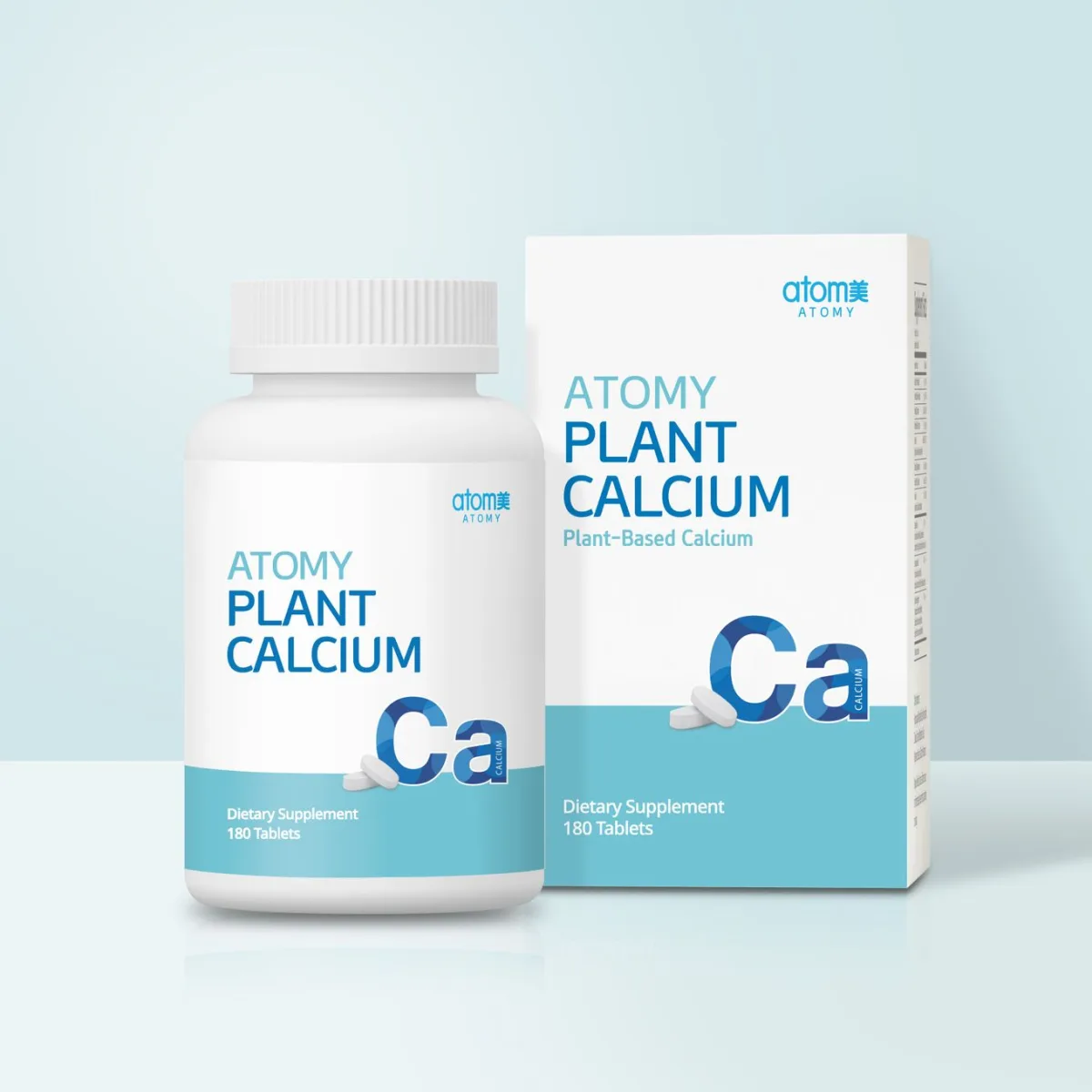
Calcium supplements look simple and are not. The word on the front of the box hides several genuinely different chemical forms, and the number that matters is not always the number printed largest. This page explains what a calcium supplement actually is, how Atomy’s sits in its range, and how to read one — without quoting quantities we cannot verify for your market.
What a calcium supplement physically is
Calcium does not exist on a shelf as a pure metal you could swallow. It is always supplied as a calcium salt — a compound of calcium with something else. The common forms in food supplements are calcium carbonate, calcium citrate, and a range of others including forms derived from mineral or marine sources.
This matters for one practical reason that has nothing to do with health effects: the compound weighs more than the calcium in it. A tablet can honestly say it contains a large amount of a calcium compound while the elemental calcium — the calcium itself — is a fraction of that. Labels handle this differently depending on the market’s rules, which is why reading the label carefully is a skill worth having.
Mineral supplements are foods, not medicines. Nothing here is intended to diagnose, treat, cure, or prevent any disease, and nothing here is medical advice. If you have a health condition, are pregnant or nursing, or take prescription medication, speak with a qualified healthcare professional before starting any supplement.
Elemental versus compound: the one label trick to learn
If you take one thing from this page, take this. When comparing two calcium products, you are looking for the figure labelled as elemental calcium, or the entry in the nutrition panel that names “calcium” as the nutrient rather than naming the compound.
Two products can look wildly different on the front of the box and be nearly identical in the panel, or vice versa. Front-of-pack numbers are marketing surface. The panel is the regulated statement.
| What you see | What it is | Comparable across brands? |
|---|---|---|
| Large number on the front | Often the compound weight, or the serving weight | No |
| “Calcium” line in the nutrition panel | The elemental calcium per serving | Yes |
| % of reference intake / %DV | Elemental amount expressed against a national reference | Only within one country |
| Ingredient name (e.g. calcium carbonate) | Which salt is used | Yes, as a form |
The third row is the one that catches people out internationally. Reference intake values are set nationally, so a percentage on a Korean label and a percentage on a British label are calculated against different baselines and cannot be compared directly.
How the forms differ, practically
We are describing chemistry and format here, not effects.
- Calcium carbonate is the densest common form, which means smaller tablets for a given amount. Packs using it very often direct you to take it with food.
- Calcium citrate is less dense, so tablets tend to be larger or servings involve more of them. Directions about food are often less restrictive.
- Mineral-source and marine-source forms appear in various products. If you have a shellfish allergy or follow a vegan or vegetarian diet, the source is something to check on the ingredient list rather than assume.
Which one a given product uses is stated in its ingredient list. That is the place to look, not a general article.
The Atomy product and its range
Atomy’s food supplement catalogue includes calcium in its mineral section. Like the rest of the range, the specific product, its form, its serving size, and its directions depend on the market you are buying in, because supplement composition and labelling are regulated nationally.
We are deliberately not reproducing a specification here. Formulations get revised, national maximum permitted levels differ, and the same product name can carry a different panel in two countries. The authoritative document is the official product page for your country, and after that the label on the pack in your hand.
Atomy itself was founded in 2009 and grew out of Kolmar Korea, a long-established contract manufacturer of cosmetics and health foods — background we cover on our company page. The product overview maps how the categories fit together.
How calcium supplements are generally taken
By mouth, as tablets or capsules, with water, according to the directions printed on the pack. Two format points recur across the category and are worth knowing before you buy:
- Tablets tend to be large. Calcium is a bulky nutrient in supplement terms. If swallowing large tablets is difficult for you, check the format before ordering — some ranges offer chewable or divided-dose options.
- Servings are often split. Many calcium packs direct you to take the daily amount in more than one serving rather than all at once. Whether yours does is on the pack.
What we will not do is tell you an amount. Directions on your pack are the instruction, and a healthcare professional is the person to advise on what is appropriate for you specifically. That is not throat-clearing: calcium is a nutrient where individual circumstances genuinely vary, and where interactions with prescription medicines are a real and well-documented pharmacy conversation. If you take anything on prescription, ask a pharmacist. It takes two minutes and costs nothing in most countries.
Combined products
Calcium is frequently sold combined with other nutrients — vitamin D and magnesium are the most common companions, and combined products are widespread across every brand. This is worth knowing for one specific practical reason: if you take a combined product and also take a separate multivitamin, you may be taking the companion nutrients twice without noticing.
Checking for that overlap is straightforward. Lay out every pack you take, read each nutrition panel, and look for repeated nutrient names. It is the single most useful five minutes anyone with a shelf of supplements can spend.
Availability differs by country
Food and supplement regulation is national. Each country sets its own permitted forms, maximum levels, labelling requirements, and rules about what may be said in advertising. So:
- A calcium product sold in Korea may not be registered for sale in the United Kingdom, the EU, or elsewhere.
- Where it is sold in more than one market, the form, the panel, and the directions may all differ.
- Reference intake percentages are not comparable across borders.
- Registrations change over time.
For what is actually available where you live, check your country’s official Atomy mall. That listing is the authority — no member site, ours included, can substitute for it.
A sensible way to approach it
- Ask whether you need a supplement before choosing one. A doctor or dietitian who knows your diet is the right source for that answer.
- Check availability in your own market.
- Find the elemental calcium figure in the nutrition panel and compare on that basis.
- Check the source if you have allergies or dietary restrictions.
- Check overlap with anything else you take.
- Ask a pharmacist about interactions if you take prescription medication.
- Follow the directions on the pack.
Our fuller guide to reading supplement labels covers the panel-reading skill in detail, and it transfers to every brand you will ever buy. EnterKR is an independent member site — see the disclosure — and questions are welcome.