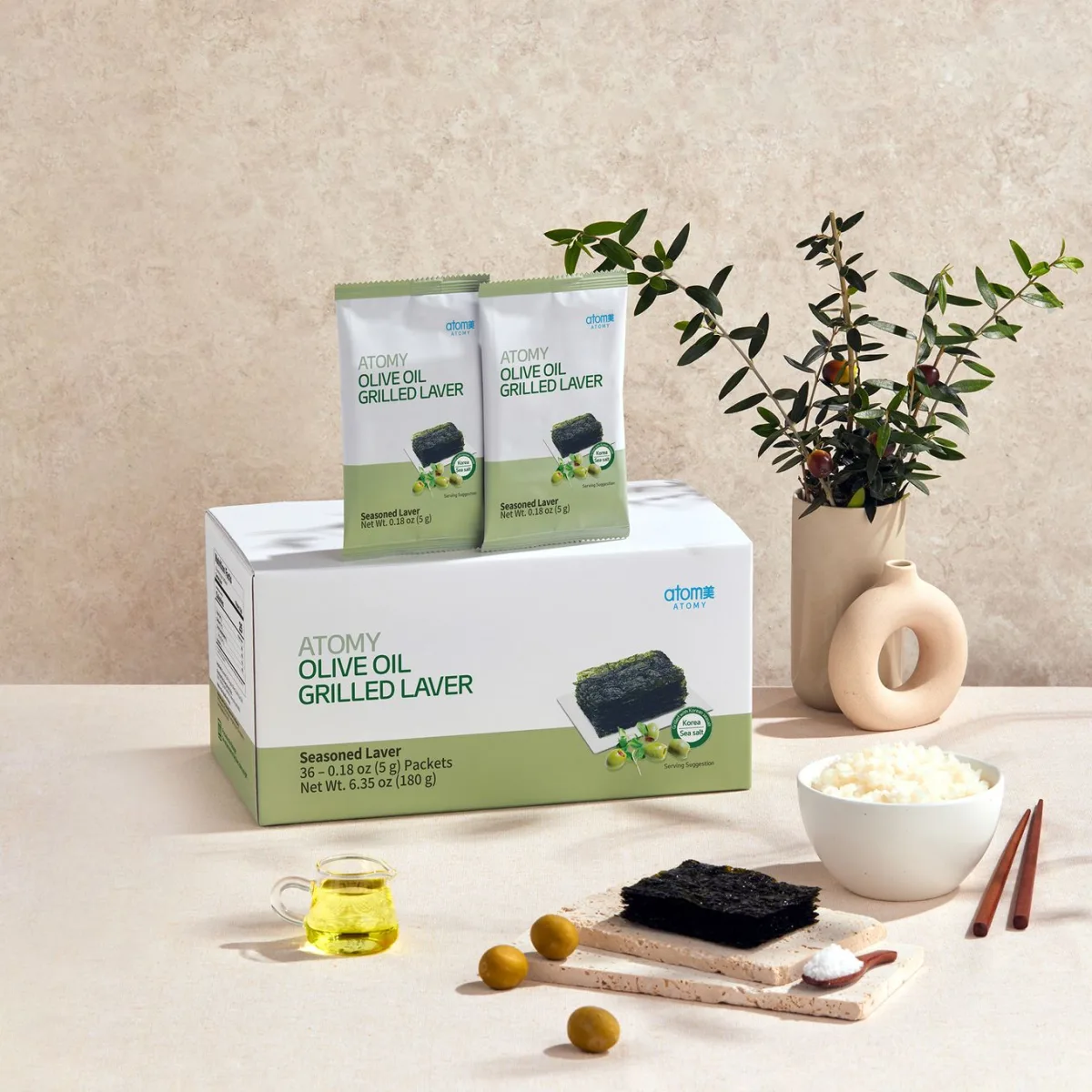
People arrive at Atomy expecting cosmetics and toothpaste and are often surprised to find a food aisle attached. It is a real part of the catalogue, and it is broader than the supplement section alone. This page maps the territory — what kinds of food products exist in the range, how they are grouped, and why what you can actually buy depends entirely on where you live.
Food and supplements are not the same thing
Worth separating at the start, because the distinction shapes everything else. In most regulatory systems there are two relevant categories:
- Ordinary foods. Things you eat or drink as food — teas, drinks, grain powders, seasonings, snacks. Regulated as food, labelled as food.
- Food supplements. Concentrated sources of nutrients or other substances, sold in measured doses — capsules, tablets, sachets, measured liquids. Still legally food in most systems, but with an additional layer of rules about composition, labelling, and permitted claims.
Both sit under “food” broadly. Neither is a medicine. The practical difference for a shopper is that supplements come with a serving size and directions, while ordinary foods do not.
Food supplements are foods, not medicines. Nothing on this page is intended to diagnose, treat, cure, or prevent any disease, and nothing here is medical advice. If you have a health condition, are pregnant or nursing, or take prescription medication, consult a qualified healthcare professional before adding any supplement to your routine.
The broad groupings
Across markets, Atomy’s food-side catalogue tends to organise into recognisable groups. Not all exist in every country.
| Group | Typical formats | Notes |
|---|---|---|
| Vitamins and minerals | Tablets, capsules, softgels, powders | The most heavily nationally regulated group |
| Herbal and plant extracts | Liquid sachets, capsules, drinks | Includes HemoHIM and noni products |
| Probiotics and live cultures | Capsules, powder sachets | Storage requirements vary by product |
| Teas and infusions | Teabags, loose, instant powders | Ordinary food in most markets |
| Grain and meal powders | Tubs, sachets | Korean misugaru-style products are a category staple |
| Drinks and juices | Bottles, pouches, cartons | Ordinary food or supplement depending on formulation |
| Seasonings and pantry items | Bottles, jars, packets | Straightforward groceries |
| Snacks and confectionery | Bags, boxes | Straightforward groceries |
The pantry and snack end of that list is the part most people do not expect. It behaves like any other grocery: you buy it, you eat it, there are no directions and no serving discipline involved.
The Korean pantry angle
A meaningful slice of the food range is recognisably Korean domestic groceries rather than international supplement products — grain powders, teas, seasonings, dried goods. For people already interested in Korean cooking, this part of the catalogue is the least complicated thing on the site: it is food, you cook with it or drink it, and nothing here requires a disclaimer beyond ordinary allergen awareness.
It is also the section that varies most between countries, for a boring logistical reason as much as a regulatory one. Shelf-stable groceries have to be worth shipping and stocking in a given market, and many are simply not exported.
Reading a food label versus a supplement label
Two different documents, and it helps to know which one you are looking at.
An ordinary food label carries an ingredient list in descending order of weight, allergen information (usually emphasised in bold or capitals), a nutrition declaration per 100g or 100ml, a durability date, and storage instructions. There is no serving size in the supplement sense and no directions for use.
A supplement label carries all of that plus a stated serving size, directions for use, a declaration of the nutrients or substances per serving, and — in most markets — a required statement that the product is not a substitute for a varied diet and should not exceed the stated daily amount. If you see directions and a serving size, you are holding a supplement.
Our guide to reading supplement labels takes this apart line by line, and the skill transfers to every brand on any shelf anywhere.
Why the range differs so much by country
This is the point people most often get wrong, so it is worth stating plainly: there is no single global Atomy food catalogue. Food and supplement regulation is national, and every country independently decides:
- Which ingredients may be sold as food or as food supplements at all.
- Maximum permitted levels for vitamins, minerals and other substances.
- What a label must say, in what language, and in what format.
- What a seller may and may not claim in advertising.
- Whether a novel ingredient requires formal safety assessment before sale.
The consequence is that a product sold openly in Korea may simply not be registered in the United Kingdom, the EU, the United States, or Australia. Where a product exists in two markets, the formulation, the label, the directions, and even the name may differ. None of that indicates anything is wrong — it is ordinary regulatory divergence between sovereign food systems.
So the only reliable answer to “is this available to me” is your country’s official Atomy mall. Check there. Product listings change over time as registrations are added, revised, or lapse.
Where the food range came from
Atomy was founded in 2009 and grew out of Kolmar Korea, a contract manufacturer with a long history of producing cosmetics and health foods for a range of brands. That lineage explains why the catalogue reaches across personal care, cosmetics, household goods and food rather than specialising in one — the manufacturing relationships were already there. We cover this on our background page, and the broader category map lives on the product overview.
That is corporate history. It is context for why the range looks the way it does, not an assertion about any individual product.
Practical notes for buying food products
- Allergens are the first thing to check on any imported food, and allergen labelling conventions differ between countries. Read the pack you actually received.
- Language matters. Products sold into a market must be labelled in that market’s required language. A pack labelled only in another language is worth asking questions about.
- Groceries and supplements need different care. A tea is a tea. A sachet with directions and a serving size deserves the same attention you would give any supplement.
- Storage instructions are on the pack and vary genuinely between products, especially for live-culture items.
- Check overlap if you take several supplements from the range. Repeated nutrients across products are easy to miss.
Where to start
If you are new to the range, the least risky entry point is the ordinary-food end: a tea, a grain powder, a seasoning. You can judge those on their own terms, in your own kitchen, with no directions to follow and no professional to consult. If you then want to look at the supplement side, our beginner’s route through the supplement range is the gentler path, and a healthcare professional is the right person to consult before you start anything with a serving size on it.
EnterKR is an independent Atomy member site, not the official corporate website — our disclosure page sets out what that means. Anything unclear, ask us.