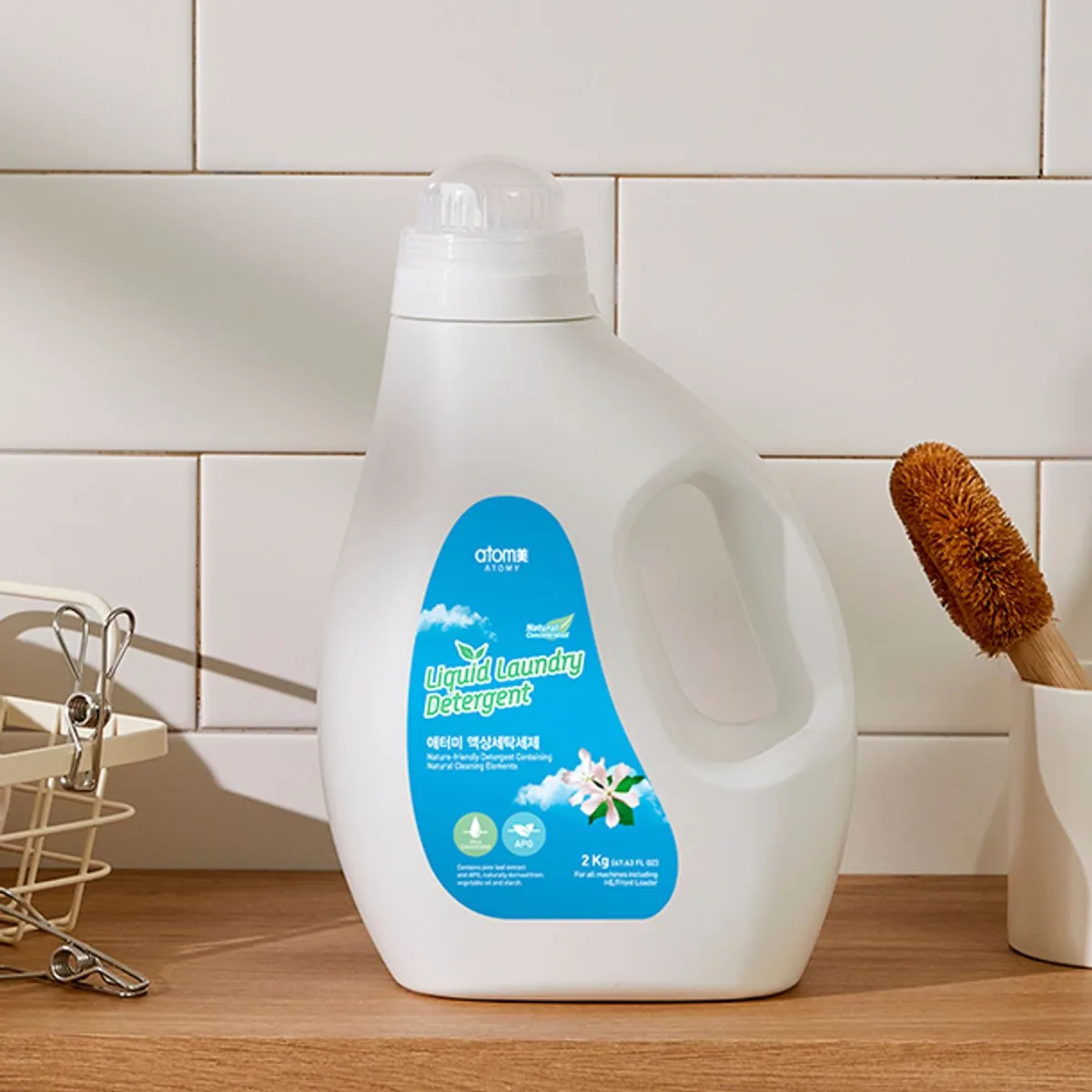
Beyond skincare and personal care, Atomy sells a range of household and laundry goods — the unglamorous end of the catalogue that, for a lot of members, is what they actually reorder. This page covers what categories exist, how the concentrated laundry format works, and what to check before switching a product you’ve used for years.
What the household range covers
The household side of the catalogue generally spans a few recognisable categories:
- Laundry detergent — typically in a concentrated liquid format.
- Fabric softener — sold separately from detergent.
- Dishwashing liquid — hand-wash format.
- Household and surface cleaners — multi-purpose and specific-surface products.
- Body wash and hand wash — sitting on the boundary between personal and household care.
- Kitchen goods — in some markets the catalogue extends to non-consumables like cookware.
Which of these is sold in your country varies quite a lot. Household chemicals face country-specific registration requirements, and the range in one market can look meaningfully different from another. Check the living or household section of your country’s official Atomy mall for what’s actually available where you are.
Concentrated laundry detergent
The concentrated format is the thing most worth understanding, because using it like a conventional detergent is the mistake people make first.
Concentrated detergent means more active material and less water in the bottle. The practical consequence is that the dose is smaller — often substantially smaller than the cap-filling habit most people have built up over years with dilute products. Using a conventional dose of a concentrated product wastes it, and can leave residue in fabrics that makes clothes feel stiff or look dull.
Getting the dose right
- Read the dosing instructions on the bottle for your market. They’re specific to that formulation and they’re the authority, not any general guide.
- Note that the cap is a measure, not a dose. Most caps have fill lines partway up.
- Adjust for load size, soil level and water hardness. Hard-water areas generally need more; light loads need less.
- Start at the lower end. If clothes come out fine, stay there. It’s easier to add than to re-rinse a whole load.
- Don’t compensate for less foam with more product. Suds level is not a measure of cleaning; high-efficiency machines are designed for low-sudsing formulations.
| Habit from dilute detergent | What to do with concentrate |
|---|---|
| Fill the cap to the top | Use the marked fill line for your load size |
| Add extra for a big load | Increase modestly, per the bottle’s guidance |
| Add more if there’s little foam | Change nothing — low foam is expected |
| Pour straight onto clothes | Use the dispenser drawer unless the label says otherwise |
| Judge value by bottle size | Judge by loads per bottle, which is the real comparison |
Comparing value honestly
Concentrated products make bottle-to-bottle comparison meaningless. A smaller bottle of concentrate can do more washes than a larger bottle of a dilute product, so the number worth working out is the cost per load:
- Find the recommended dose in millilitres from the label.
- Divide the bottle volume by that dose to get loads per bottle.
- Divide what you paid by loads per bottle.
Do the same for your current detergent and you have a genuine comparison. For current pricing in your market, check your country’s official Atomy mall — we don’t publish figures here because they differ by country and change over time.
Nothing on this page is medical advice, and none of it is a substitute for professional guidance. Household cleaning products are chemicals: follow the safety information on the label, keep them out of reach of children, and if a product is swallowed or causes a reaction, contact your local poison information service or a doctor immediately.
Safety and storage basics
Standard practice with any household chemical applies here too:
- Keep products in their original containers, with the label intact. Decanting into unlabelled bottles is how accidents happen.
- Store out of reach of children and pets, ideally in a cupboard that latches.
- Never mix cleaning products. Combining products — particularly anything containing bleach with anything acidic — can produce hazardous fumes.
- Ventilate when using surface cleaners in small rooms.
- Read the hazard symbols on the label for your market. They’re standardised and they’re there for a reason.
- Gloves for prolonged contact, particularly with dishwashing over a long session.
Switching a product you’ve used for years
Laundry in particular is a category where people have strong habits, and switching everything at once means you can’t tell what changed. A more useful approach:
- Change one product at a time. Detergent first; keep your usual softener for a few weeks.
- Test on ordinary loads first, not on something you’d be upset to damage.
- Give it a few washes. Fabrics carry residue from previous detergents, so the first load isn’t a clean test.
- Check delicate items separately, and follow both the garment care label and the detergent label.
- Note the scent. Laundry fragrance is highly personal and lingers on everything you own, so it’s worth trying a small size first if one is sold.
Ingredients and formulations
As with the rest of the catalogue, we don’t publish ingredient lists. Household product formulations differ by market to meet local regulations and are revised over time. The bottle in your hand carries the declaration and the safety information that apply to it; the current product page on your country’s official Atomy mall carries the current version. If someone in your household reacts to a particular fragrance or surfactant, check by name on the actual label.
Why this part of the range matters
Household consumables are the least exciting products in any catalogue and often the most telling. They’re things you were going to buy anyway, they get used up on a predictable cycle, and there’s no ambiguity about whether they worked — your clothes are clean or they aren’t. If you’re weighing up whether a catalogue is worth your time, this is a more honest test than a premium skincare set, and it’s the reasoning we set out on our why Atomy page.
Membership is free to register — see the joining page — and our disclosure statement explains our relationship to the company. This is an independent member site, not Atomy’s official site.