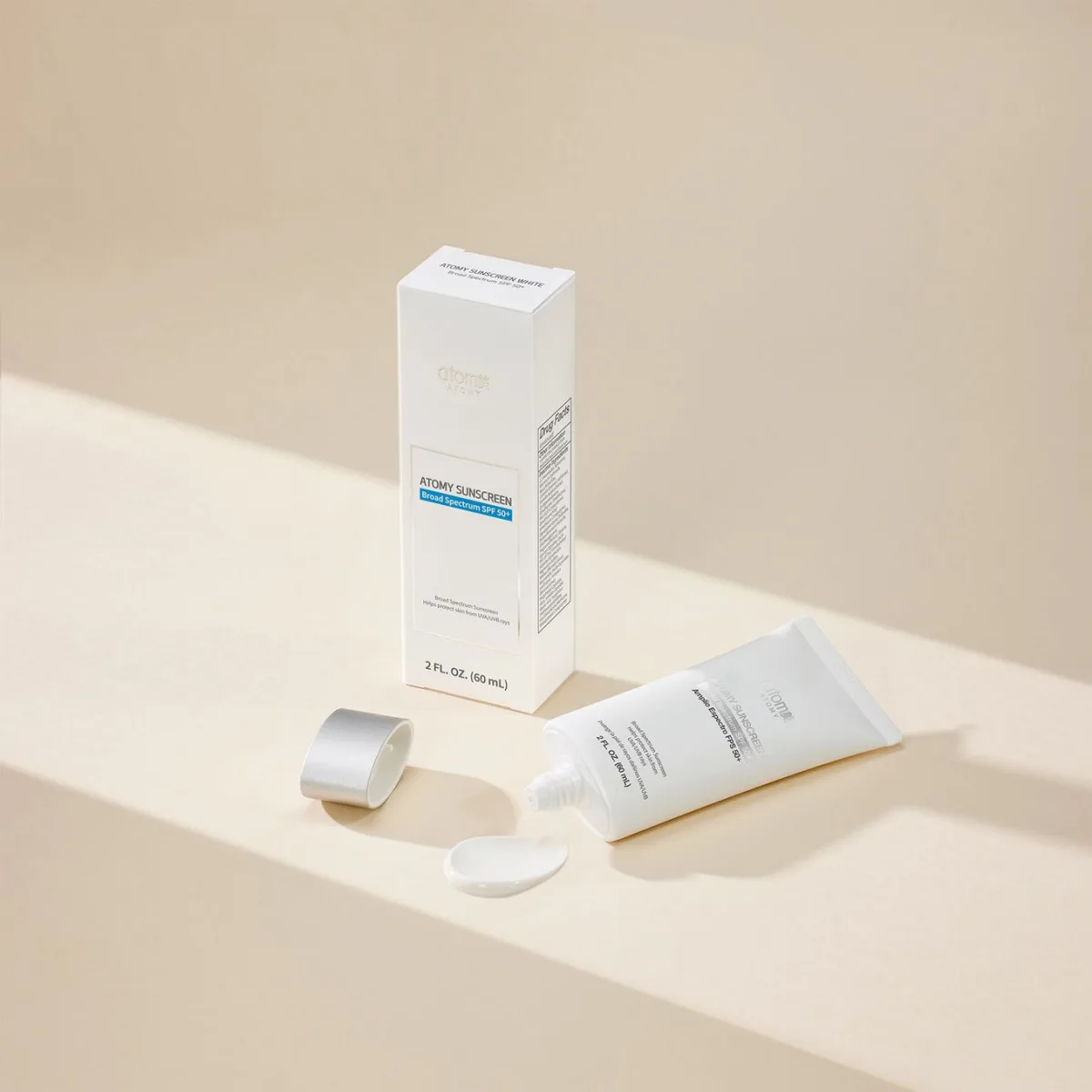
Sun care is the step most people in the routine skip, and it’s also the one where Korean formulations have the strongest reputation for being pleasant to wear. This page covers the formats you’ll find, how to read the labelling, how much to apply, and why the sunscreen you’ll actually put on every day beats the one that sits unopened.
Where sunscreen sits in the routine
Last, in the morning, always. After toner, essence, lotion and whatever else you use — sunscreen is the final skincare step before makeup, if you wear any. Putting moisturiser on top of it disturbs the film you’ve just applied, which is the single most common ordering mistake people make.
It’s a morning-only step. There’s no reason to apply it at night, and doing so just adds a layer you’ll have to cleanse off.
The formats
Sun products come in several formats and the choice is mostly about texture preference and how you’ll use them:
| Format | Character | Suits |
|---|---|---|
| Cream | The standard format; a tube or squeeze bottle | Everyday face use |
| Fluid / milk | Thinner, spreads easily | People who dislike heavier textures |
| Gel | Light, often the least tacky | Warm weather, oilier skin |
| Stick | Solid, applied by rubbing on | Reapplication over makeup, bags, travel |
| Cushion or compact | Pressed or sponge-applied, often tinted | Topping up during the day |
| Spray or mist | Aerosol or pump | Body, hair line, reapplication |
Which of these Atomy currently sells depends entirely on your market. Sun products are regulated differently across countries — in some they’re cosmetics, in others they’re classed separately — which means the range genuinely varies. Check the sun care section of your country’s official Atomy mall for what’s available where you are.
Reading the labelling
Two things appear on nearly every sun product, and they measure different things:
- SPF is a number relating to UVB. Higher numbers indicate a higher rating on that scale.
- PA followed by plus signs (PA+ through PA++++) is the Asian-market system relating to UVA. In Europe you’ll instead see a circled UVA symbol; in other markets the term “broad spectrum” is used.
Because the systems differ by region, the same formulation can carry different-looking labelling in different countries. The figures printed on the pack you’re holding are the ones that apply to it. Check the actual product page for your own country rather than a specification quoted from another market.
This page describes product formats and how to apply them. It is not medical advice and is not a substitute for professional care. For guidance on sun protection appropriate to your own skin, any medication you take, or any concern about a mole or a change in your skin, speak with a doctor or dermatologist.
How much to apply
This is where nearly everyone falls short. Laboratory ratings are measured at a specific density of product per area of skin, and most people apply well under that in ordinary use, which means the protection they get is lower than the number on the tube suggests.
Practical guides for the face:
- Two finger lengths — a line of product along the index and middle finger, from base to tip — is the commonly cited measure for face and neck.
- Roughly a large coin poured into the palm is another way of eyeing the same quantity.
- Apply in two passes if a single layer feels like too much at once. It also gives more even coverage.
- Don’t forget the ears, the sides of the neck, the eyelids as far as is comfortable, and the back of the hands.
Reapplication through the day is standard guidance in most markets, particularly after swimming, sweating or towelling. Sticks and cushions exist largely because reapplying a cream over makeup is awkward.
Why Korean sun care has the reputation it does
Korean and Japanese sun products have a strong following internationally, and the reason is mostly cosmetic elegance rather than anything mysterious. The formulations tend to be lighter, less likely to leave a visible white cast, and pleasant enough to wear that people apply them daily. That last point is the whole game: a product you enjoy putting on gets used, and one that feels like paste on your face does not.
Atomy’s sun products sit within that broader Korean formulation tradition. Whether a specific one suits you comes down to finish — some people want matte, others don’t mind a dewy look — and to whether any tint matches your skin tone.
Common mistakes
- Applying too little. By a wide margin the most common issue.
- Applying it too early in the sequence. It goes last, not before moisturiser.
- Relying on the SPF in makeup or moisturiser. Foundation is rarely applied at anything approaching the density these ratings are measured at.
- Only using it in summer. UVA levels are less seasonal than sunshine hours suggest, and daily use is the standard advice in most markets.
- Piling products on top. If your sunscreen pills or rolls off, there’s usually too much underneath it. Thin the layers below rather than abandoning the sunscreen.
- Keeping an old tube. Sun products have expiry and period-after-opening markings for a reason. Last year’s half-used bottle isn’t the one to rely on.
Checking ingredients
We don’t reproduce ingredient lists or filter specifications on this site. The permitted UV filters differ between regulatory regions, formulations get revised, and a specification copied from another market can be simply wrong for the product in your hand. Read the carton, or check the current product page on your country’s official Atomy mall. If you have a known sensitivity to a particular filter or fragrance, check by name on the packaging before buying.
The short version
Sunscreen goes on last in the morning, in more quantity than most people use, every day rather than seasonally. The format matters mainly because it determines whether you’ll keep using it. Labelling systems differ by country, so read the pack sold in yours — and check the product page on your country’s official Atomy mall for what’s currently available. For where this fits in the wider sequence, see our routine order guide; our disclosure page explains our relationship to the company, and this site is not Atomy’s official site.