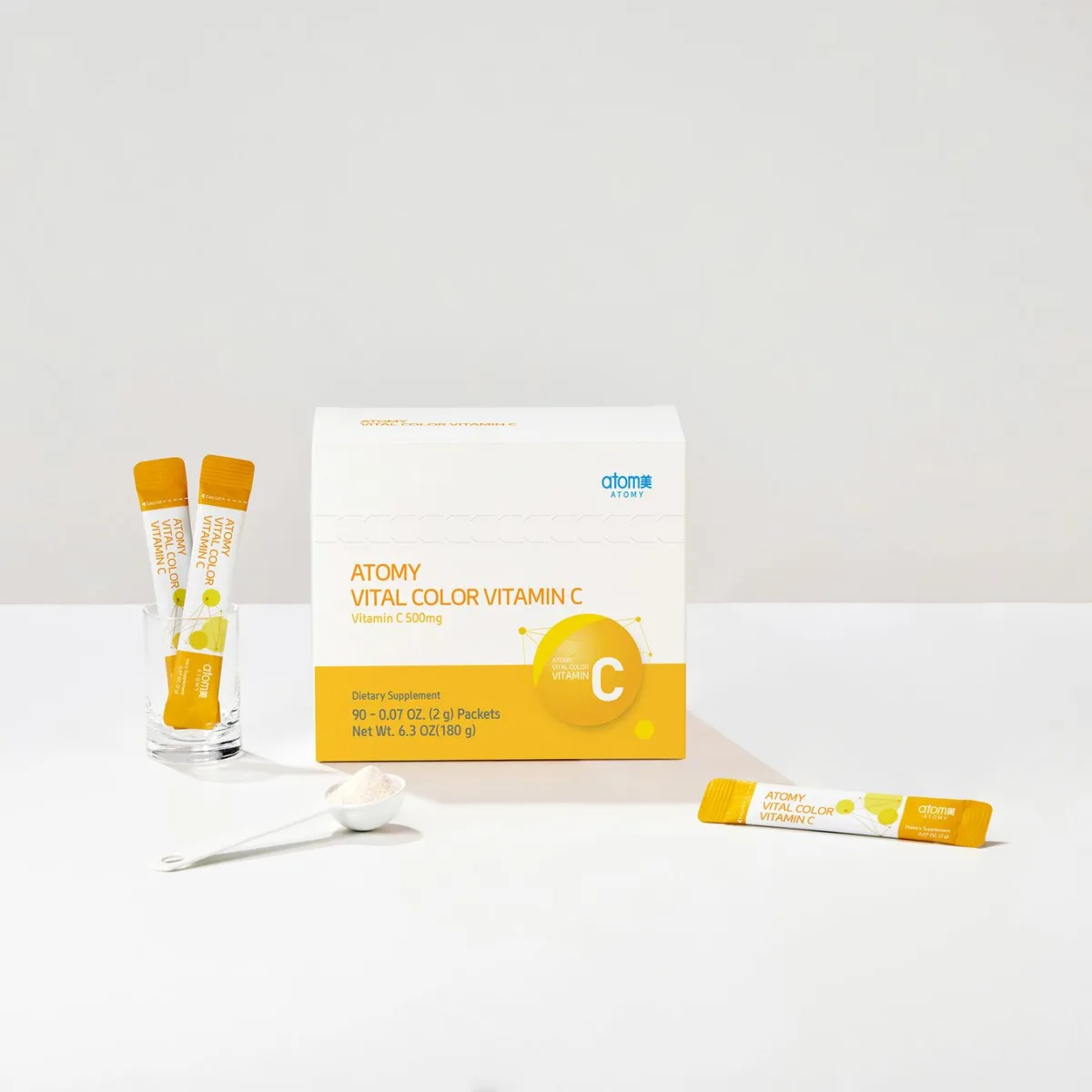
Vitamin ranges are confusing in a specific way: the names look scientific, so people assume there is a right answer waiting to be found, when in practice most of the decision comes down to format, availability where you live, and whether you will actually take the thing. This page explains how Atomy’s vitamin range is organised and how to think about the categories, without inventing figures we cannot verify.
How the range is organised
Atomy’s food supplement catalogue includes a vitamin section, and like most such ranges it divides along two axes that matter more than anything else:
- Single vitamin versus multivitamin. A single-nutrient product covers one thing. A multivitamin covers a broad panel in one dose.
- Format. Tablet, capsule, softgel, powder, or liquid. This determines the swallowing experience, the flavour experience, and often the packaging.
Beyond that, ranges usually differentiate by intended audience — an adult product, a product formatted for children, a product formatted for people who dislike tablets. The specific line-up available to you depends entirely on your country.
Vitamin supplements are food products rather than medicines. Nothing on this page is intended to diagnose, treat, cure, or prevent any disease, and none of it is medical advice. If you have a health condition, are pregnant or nursing, or take prescription medication, speak with a qualified healthcare professional before starting any supplement.
The one thing we will not give you: numbers
You will notice this page contains no milligram figures, no international units, and no percentages of any reference intake. That is deliberate.
Supplement formulations are revised, and — more importantly — the same product name can carry different amounts in different markets, because national regulators set their own maximum permitted levels for vitamins in food supplements. A figure that is correct for a Korean pack may be wrong for a British one, and a member site quoting a stale number is actively worse than one quoting none.
So for any actual quantity, the source is the official product page for your country, or the label on the pack in your hand. Both are current in a way we cannot be.
The vitamin categories, briefly
Understanding the two broad families makes label-reading easier:
| Family | Members | Practical implication |
|---|---|---|
| Fat-soluble | A, D, E, K | Often formulated as softgels; packs frequently direct you to take them with food |
| Water-soluble | C, and the B group | Usually tablets or powders; some have a noticeable taste; excess is generally not stored |
That distinction is the reason directions vary between products in the same range. It is not arbitrary and it is not marketing — it follows from how the molecules behave.
Note what the table does not do: it does not tell you what any of these do in the body, or suggest that you need any of them. That is a matter between you and a healthcare professional who knows your diet and circumstances.
Multivitamin or single nutrient?
This is the most common question and it has an honest answer: it depends on whether you have a specific reason to target one nutrient.
A multivitamin is a broad, low-effort option. One item, one routine, everything in the panel covered at whatever level the formulation provides. The tradeoff is that you get everything in the panel whether it is relevant to you or not, and you cannot adjust one component without adjusting all of them.
A single-nutrient product is precise. You take exactly the thing you meant to take. The tradeoff is that you need a reason to have chosen it, and working out whether you have such a reason is genuinely a job for a professional — a blood test and a doctor beat a guess and an internet search every time.
If you have no particular reason and simply want a general product, most people default to a multivitamin. That is a reasonable default rather than an optimisation.
Format matters more than people expect
The best supplement is the one you take. Format is the largest single predictor of that, and it is worth choosing deliberately:
- Tablets are compact and stable, but large ones are a genuine obstacle for some people.
- Capsules and softgels are usually easier to swallow. Softgels suit oil-based formulations.
- Powders and effervescents mix into water. Easiest for people who cannot swallow pills; you do taste them.
- Chewables and gummies remove swallowing entirely and are common in ranges aimed at children.
- Liquids are flexible on portioning but you taste them fully.
If you have abandoned a supplement before, ask whether the reason was the format rather than the product. It usually was.
Availability differs sharply by country
This deserves emphasis in the vitamin category specifically, because it is the category where national divergence is widest. Every country sets its own rules on which vitamin forms may be sold, at what maximum levels, with what labelling, and under what claims regime. The European Union, the United Kingdom, the United States, Korea, and Australia all differ, sometimes substantially.
The consequences are concrete:
- A product sold in Korea may not be registered for sale where you live.
- A product with the same name in two markets may have a different formulation and a different label.
- Directions on the pack may differ between markets for the same product.
- Any of this can change as registrations are updated.
The only reliable answer to “can I buy this?” is your country’s official Atomy mall. Check there rather than relying on a description — including this one. Our product overview explains the categories; it cannot tell you what is stocked in your market.
Where Atomy’s vitamins come from
Atomy was founded in 2009 and grew out of Kolmar Korea, a contract manufacturer that has long produced cosmetics and health foods for other brands. That origin is the reason the catalogue leans toward formulated products across categories rather than assembled commodity lines, and we go into it in more detail on our background page.
That is company history, not a quality claim. Manufacturing lineage tells you about the origin of a product range. It does not tell you whether a particular product suits you.
How to choose, practically
- Ask whether you need one at all. A healthcare professional who knows your diet is the right person to answer this, not a website.
- Check availability in your country before shortlisting anything.
- Read the actual label — the real one, for your market. Learning to do this well pays off across every brand.
- Choose a format you will tolerate daily. Be honest about pill size.
- Check for overlap if you already take something. Two multivitamins is a mistake people make routinely.
- Follow the directions on the pack. Not a figure from a forum.
EnterKR is an independent Atomy member site, not an official corporate channel — see our disclosure. If you want to start from the very beginning, our beginner’s guide is the gentler entry point, and questions are welcome.